A Fallen Log Is Not an Empty Place
A fallen log is a changing miniature landscape. Learn what to notice in its bark, moss, fungi and hollows without disturbing its quiet inhabitants.
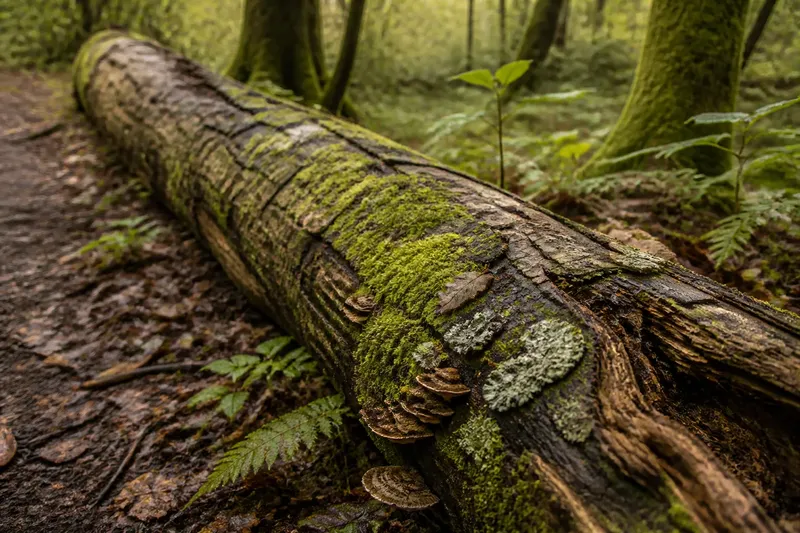
You step over a fallen log on a woodland path and feel its damp bark give slightly beneath your boot. Look closer, though, and the trunk is less a discarded tree than a narrow landscape, with ridges, hollows, soft growth and tiny routes for living things. A fallen log rewards attention because its surface keeps changing while remaining in the same place.
Why does a fallen log become a small landscape?
A fallen trunk lies across the ground, where rain, shade, soil and passing animals meet. Its bark forms a rough terrain: raised plates catch leaf litter, cracks hold moisture, and the underside may stay cool and dark. Each feature makes a different little condition within the length of a single tree.
The log also changes gradually. Bark loosens, wood softens, and fragments settle into the woodland floor. Moss may spread across a damp face while a sunlit section stays comparatively bare. Those contrasts make the trunk feel less like one object and more like a sequence of adjoining places.
It is worth looking along the whole log rather than focusing on its most colourful patch. A smooth cut end, a broken branch stub and a deep split can each shape the way water gathers or light reaches the wood. The trunk’s form is part of its living character.
What can the bark and wood tell you?
Bark is often the first surface to catch the eye, but its pattern is not a label that identifies every visitor. Notice whether it is tight or lifting, dry or dark with moisture, and whether its cracks run lengthwise or break into small plates. These details help you see how the log’s surface varies from one section to another.
Exposed wood offers another set of textures. A broken end may show pale fibres, while a damp crevice can look darker and softer. You may spot small holes, shallow grooves or loose flakes. Treat these as signs of activity or change, not as proof of a particular species or cause.
Imagine you find a log beside a shaded path, with one side pressed against wet leaf litter and the upper face open to filtered light. If you compare those two sides without touching them, you might notice moss gathering below and drier bark above. The visible difference gives you a simple way to read how position shapes the trunk’s surface.
Why do moss, fungi and lichens appear in patches?
Different organisms make use of different conditions, so their growth is often uneven. Moss is easy to notice where the surface stays moist; lichens may appear on exposed patches; fungi can emerge from a split or from the wood itself. Their shapes and colours can turn a plain stretch of bark into a mosaic.
Look for boundaries as well as individual forms. A soft green cushion may stop where bark rises, while a pale crust follows the grain on a flatter section. A cluster of fungi can mark a change in the wood, but its appearance alone does not tell you everything about what is happening inside the trunk.
Colour is useful, but texture often gives the more satisfying clue. A fuzzy edge, a firm crust or a smooth cap can be easier to distinguish than subtle shades in woodland light. Avoid picking or scraping to get a better view; close observation does not need to become collecting.
Who might use the spaces around a fallen log?
A log can offer shelter as well as a surface to grow on. Insects may use gaps in the bark, while small animals can pass beneath or beside the trunk. Leaf litter trapped against the wood creates another layer of cover. The log’s importance lies not in a single occupant but in the range of sheltered spaces it provides.
Signs can be slight: a web stretched across a crevice, a leaf tucked into a hollow, or a narrow track through damp debris. Pause before leaning over a gap or moving bark. An empty-looking opening may be occupied, and a quiet minute can reveal more than a poke with a stick.
For a useful observation, choose a spot where you can stand without blocking the path. Watch the same section briefly, then look again from a little farther back. You may notice that the trunk connects the ground beneath it with the plants growing beside it, rather than sitting apart from the rest of the woodland.
How does a fallen log change as it breaks down?
As wood weathers, the trunk’s outline can soften and its pieces begin to blend with the ground. A raised ridge may sink beneath leaves; a split can widen; the surface may become crumbly. The changes are usually gradual enough that a single visit shows only a moment in a longer process.
Moisture, exposure and the tree’s condition all influence what you see. A sheltered section may remain damp, while a more open end dries between showers. Fallen trunks do not all follow one neat sequence, so it is better to describe the features in front of you than to assume every log will look the same.
If you return to the same path, use an unchanged landmark such as a nearby bend or stone to find the trunk again. A mental note about the moss line, a broken limb or the shape of a hollow makes later changes easier to notice. There is no need to mark the tree or move anything around it.
How can you observe a fallen log without disturbing it?
Stay on the path where possible and look from more than one angle. A phone camera can help you keep a record of broad changes, but it is not necessary; the outline, texture and arrangement of growth are often easier to remember after a quiet look.
- Notice how the trunk meets the soil and whether its underside is visible.
- Compare a shaded face with one that receives more light.
- Look for bark cracks, hollows and loose sections without lifting them.
- Observe moss, lichens and fungi as shapes as well as colours.
- Check how leaves and small plants gather around the log.
- Return later and compare one recognisable feature.
What is not worth the effort? Trying to name every fungus or insect from a quick glance can distract from the pattern of the whole trunk. If identification matters, use a trusted field guide or ask a knowledgeable local naturalist, and leave unfamiliar growth in place.
What should you look for on your next walk?
Is a fallen log still part of the woodland?
Yes. It remains connected to the soil, nearby plants and sheltered spaces around it, even as its wood changes. Looking at those connections is more revealing than treating the trunk as leftover material.
Does every fallen log support the same kinds of life?
No. The tree, its condition, the surrounding moisture and the amount of shelter all shape what can be seen. Two logs a short distance apart may have noticeably different surfaces and visitors.
Can I touch or move a piece of bark to see underneath?
It is better to leave bark and loose wood where they are. Looking into an existing opening gives you a view while avoiding disturbance to any small creature or growth using the space.
What is the simplest way to notice change?
Choose one visible feature, such as a mossy ridge or exposed branch stub, and compare it on a later visit. A fallen log is a small landscape, and its gradual changes become clearer when you know where to look.
Next time you meet one across a woodland path, pause at its edge and follow its shape from end to end. That single habit turns a step around an obstacle into a closer reading of the woodland floor, where even a quiet piece of wood has texture, shelter and a story still unfolding.