A Winter Window for Watching Bird Silhouettes
A winter window for watching bird silhouettes turns ordinary visits into a calm record of posture, movement and shape, without needing a name for every bird.
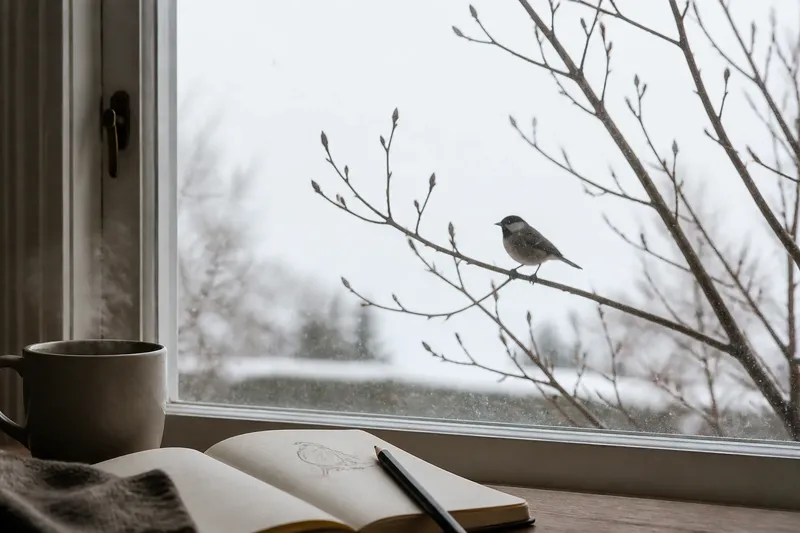
A small bird lands on the bare lilac outside the kitchen window, pauses, then slips behind a branch before the kettle boils. A winter window for watching bird silhouettes gives that brief visit a little more room: you can follow the shape, posture and movement without needing to identify every bird.
There are several ways to settle into this kind of observation. You might watch freely whenever a visitor appears, keep a short routine at a familiar window, or make a simple visual record. Each approach suits a different household and temperament; the best one is the one that leaves you looking outward rather than worrying about doing it properly.
Begin with the view you already have
Choose a window where you can sit comfortably and see a useful stretch of branches, hedge, fence or ground. A view does not need to be grand. One exposed twig against a pale sky can make a bird’s outline easier to follow than a busy garden full of overlapping foliage.
Before settling in, notice what the glass and room contribute. Reflections can obscure a bird, while a bright lamp behind you may appear on the pane. If it is comfortable, sit slightly to one side of the strongest reflection and let your eyes adjust. Do not tap the glass, open a window to get closer, or move towards a bird that is using nearby cover.
Keep the setting uncomplicated. A chair, a notebook and a pencil are enough; binoculars are optional if they help you look without pressing close to the glass. On a cold day, a warm drink can make a quiet pause pleasant, but avoid balancing it where a sudden movement might send it onto the sill or floor.
Choose between three ways of watching
Watch freely when a bird appears
This is the loosest approach: look up when movement catches your eye and follow the visitor for as long as it stays. Notice its outline against a branch, the angle of its body, and whether it hops, sidles or flies in a direct line. You need not prepare a schedule or keep a record.
Free watching suits people with busy days, young children nearby, or a window that offers occasional rather than regular visits. Its advantage is ease; its limitation is that impressions may blur together. If several small birds arrive in quick succession, you can still notice one useful detail and let the rest pass.
Keep a short, familiar window routine
A routine means returning to the same view at a time that fits naturally into the day, such as while breakfast cools or after lunch. Settle for a modest spell, look first at the whole scene, then choose one place where a bird might pause. The point is not to wait for a particular species, but to become familiar with the view’s ordinary movement.
This approach suits anyone who enjoys a quiet daily ritual or wants to notice changes in the same birds’ behaviour as winter progresses. It may feel less rewarding if you expect a visitor every time. On a quiet day, the shape of a branch against the sky, a wind-stirred twig or a bird crossing the far edge of the view can still give your attention somewhere to rest.
Make a small silhouette record
If you like to look back at what caught your attention, sketch a few lines or write a short note after watching. Draw the body as a simple shape, then add the tail direction, head position and the branch or surface it used. A rough mark is more useful than a polished drawing if it helps you remember what you actually saw.
This suits curious observers who enjoy comparing impressions, and it can be especially welcome if names do not come easily. A record also asks for a little more effort: you have to pause, find a notebook and decide what to save. Keep it brief so the page supports the observation rather than taking your eyes away from the bird.
Notice the outline before guessing the name
Start with the broad shape. Is the body compact or elongated? Does the tail look short, level or pointed down? Is the head held upright, tucked close to the shoulders or turned sharply towards something? These are observations, not a test, and several different birds can share a similar outline at a distance.
Posture offers another layer. A bird perched low may look rounded, while the same bird stretched forward can seem much longer. Watch where its weight appears to sit: balanced over both feet, leaning towards a branch, or poised to move. A silhouette cannot show every marking, but it often makes these shifts plain.
Then attend to movement. A quick hop is different from a steady walk along a branch; a short flutter between perches differs from a direct crossing of the sky. You can describe what happened in ordinary words. “Two hops, a pause, then down into the hedge” is a perfectly good note without a species name.
Imagine you see a dark shape on a fence, then watch it turn, lower its head and spring into a shrub. Rather than deciding at once that you know the visitor, you might note a rounded body, a tail angled slightly down, and a single quick leap. The next sighting may add a different clue, or it may simply remain an enjoyable, unnamed moment.
Use a few prompts without turning the pause into homework
A small set of questions can guide your attention when a view feels busy. Choose one or two, not all of them, and let the scene lead.
- Where does the bird pause? Note whether it favours an open twig, the sheltered side of a hedge, a fence rail or the ground.
- How does it hold its body? Look for a level back, a forward lean, a puffed outline or a low crouch.
- What happens just before it moves? A head turn, a brief stillness or a shift of weight may precede a hop or flight.
- Which part of the silhouette is easiest to see? The tail, beak, crest or overall body shape may stand out against a particular background.
- Does it return to the same place? A repeated perch can make later visits easier to follow, even if the bird remains unidentified.
These prompts are not a checklist to complete. If the light changes or a bird disappears behind the hedge, simply keep the detail you noticed and leave the rest. The calm of the pause matters more than producing a complete account.
Which winter window approach suits you best?
Do I need to know bird names to watch silhouettes?
No. You can describe outline, posture, direction and movement without identifying the visitor. If a name later becomes interesting, compare your notes with a reliable bird guide, but there is no need to turn each sighting into a quiz.
What is best for a busy day?
Free watching is the easiest option because it asks for no planned time or record. Notice one feature when a bird appears, then return to what you were doing without feeling you have missed a session.
How can I keep a child interested at the window?
Invite them to follow one visible feature, such as the tail or the bird’s next hop, and let them describe it in their own words. A short shared pause can work better than asking them to sit still until a bird arrives.
Should I draw every visitor?
No. Sketch only when drawing helps you look more closely or remember a distinctive posture. If making marks distracts you from the view, leave the notebook shut and keep a brief mental note instead.
Keep the window comfortable and the birds undisturbed
Choose a position where you can remain still without straining your neck or leaning on the sill. A side-on seat can reduce reflections, and a curtain partly drawn behind you may help soften glare if it does not block the view. Avoid bright phone screens while watching; they can pull your attention back into the room.
Let the outside scene stay as it is. Do not chase a better angle by approaching a bird’s perch, and avoid leaving food on a sill simply to bring visitors closer. If you already maintain a feeder, follow its maker’s cleaning directions and keep your watching position separate from any task that involves handling it.
What is not worth the effort is trying to record every arrival, make a perfect sketch or hold a bird in view after it has moved away. A fleeting glimpse does not need to be rescued. The shape crossing a patch of winter sky may be enough for that moment.
Let the view change with the season
As winter moves along, the same window can present different outlines. A bare tree opens up sightlines that leaves once concealed; low light may turn a bird into a dark cut-out, while a brighter patch of sky can reveal the tilt of a tail or the curve of a back. The background changes, and so does what your eye can pick out.
Try returning to a familiar perch rather than hunting for novelty. You may notice a bird using it at a different angle, waiting longer before it moves, or choosing a sheltered branch on a windy day. These are small observations, but they make the winter window feel particular to your home and its patch of outdoors.
For a winter window for watching bird silhouettes, choose free watching if you want the least fuss, a familiar routine if you welcome a quiet daily pause, or a brief record if you enjoy noticing details over time. You can move between them whenever the day calls for it. Let one clear outline, one turn of the head or one quick departure be enough to carry your attention back indoors.