The Long Art of Naming Clouds
Cloud names make sky-watching more attentive: follow a simple week-long routine to notice changing forms, compare them and describe what you see.
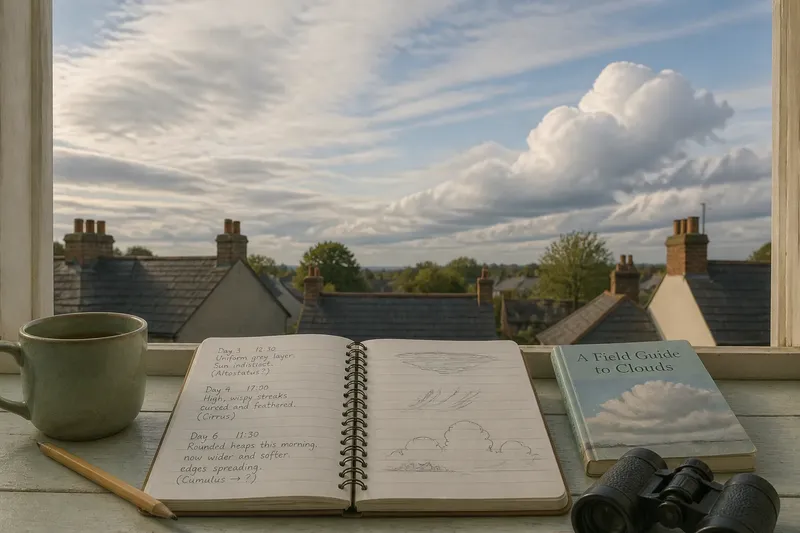
On a grey morning, a ragged strip of cloud slides across the gap between two rooftops. By lunchtime, the sky above the same street may hold a smooth veil, a tower with a dark base, or no cloud at all. Cloud names give these passing shapes a shared vocabulary, and learning them can turn a quick glance upwards into a habit of careful observation.
The names are not labels to memorise for their own sake. They are prompts: Is this cloud a sheet or a heap? Is it low or high? Is it growing, thinning or breaking apart? A week of short observations is enough to begin noticing how the sky changes, without trying to forecast the weather from every wisp.
Cloud names begin with shape and height
Many familiar cloud names come from a few recurring forms. Stratus describes a broad, layered appearance; cumulus suggests a heap or mound; and cirrus refers to fine, fibrous-looking clouds high in the sky. Alto is used in names for middle-level clouds, while nimbus points to rain-bearing cloud. These parts combine in names such as altostratus and cumulonimbus.
That vocabulary helps separate clouds that might otherwise all be called “grey” or “fluffy”. A low, flat stratus layer can make the sky look like a ceiling. Cumulus clouds have rounded tops and distinct outlines, while cirrus often appears as delicate streaks or filaments. Real skies can be mixed, and a cloud may change shape as it moves or develops, so a name is a useful description rather than a permanent identity.
For a first look, describe what is visible before reaching for a term. Notice the cloud’s outline, texture, apparent height and relation to the horizon. Then compare those details with a field guide or a reputable cloud chart. The order matters: looking first helps keep the name from deciding what you think you see.
A week of looking makes the vocabulary useful
Choose one place you can revisit, such as a garden, a bus stop or a window with a broad view. Spend a few minutes there at roughly the same part of the day, if that fits your routine. A pocket notebook is enough; a phone camera can help, but it is optional. Record the time of day, a short description and the direction you faced.
- Day one: Write down ordinary words for the sky: streaked, layered, lumpy, hazy or clear. Avoid trying to name everything.
- Day two: Look for distinct heaps or towers, and notice whether their edges are sharp, soft or spreading.
- Day three: Watch for layers or veils. Check whether the sun is clearly visible, blurred or hidden.
- Day four: Search for fine, high-looking streaks and note whether they seem straight, curved or feathered.
- Day five: Compare the horizon with the sky overhead. Are the clouds similar across the view, or does their form change with distance?
- Day six: Return to a cloud you have already described. Note whether it has thickened, thinned, joined another patch or disappeared.
- Day seven: Look back through your notes and choose one observation to describe with a cloud name, explaining which visible features support it.
Keep the entries brief. “A low grey layer, broken above the rooftops” is more useful than a confident label unsupported by what you can see. If a field guide suggests stratus, you can add that as a tentative identification and keep the plain-language description beside it.
Look for change, not just a perfect match
Clouds are moving and changing forms, so the most interesting observation may be a transition. A compact heap can grow taller; its edges can soften; separate patches may merge into a wider layer. Record what happened between visits rather than treating each sky as an isolated picture.
Say you notice a small, rounded cloud above a park in the morning. Later, it appears broader and less distinct, with neighbouring clouds spread across more of the sky. Your notebook might say “rounded heap, then wider and softer”, followed by a cautious note that the first form resembled cumulus. The point is not to claim that one named cloud inevitably becomes another; it is to preserve the visible sequence.
Position matters, too. A cloud near the horizon can look smaller or flatter than a similar cloud overhead, and distant haze may blur its outline. Try describing the whole view as well as one feature: “a band of layered cloud to the west, with broken patches above”. That gives the name a setting and makes later comparisons easier.
What can cloud names tell you about the weather?
Does a cloud name predict rain?
Some names describe clouds commonly associated with precipitation, but a name alone is not a local forecast. For everyday plans, check a suitable weather forecast and treat cloud watching as observation rather than a substitute.
How can I tell stratus from altostratus?
Both can appear as broad layers, so compare their apparent height, texture and effect on the light. A field guide can help with the distinction, but a careful description such as “uniform grey sheet, sun indistinct” is still useful if the exact name is uncertain.
Can a cloud have more than one form?
Clouds can develop, fade or blend into neighbouring forms, and a large cloud may show different shapes in different parts. Describe the feature that stands out, or note the change over time, rather than forcing a single label onto the whole sky.
Do I need a camera or an app?
No. A notebook and a view of the sky are enough to practise noticing shape, texture and change. A camera or identification app can be handy for comparing observations later, but neither replaces looking closely at the clouds in front of you.
Make a personal cloud vocabulary
Standard names let people compare what they see, but your own plain-language notes make the record more precise. Keep a small list of phrases that suit your local view: “thin veil over the hills”, “soft towers above the roofs”, or “low layer with a torn edge”. Beside each phrase, add a cloud name only when the form seems to fit.
One short sketch can also capture a feature that words miss. Use a few lines to show whether a cloud has a rounded top, a flat underside or long trailing strands. There is no need to draw the whole sky. A rough outline beside the time and direction can make the entry recognisable when you revisit it.
What is not worth the effort is trying to catalogue every cloud or checking an identification app after every glance. That can turn a quiet habit into a test. A couple of observations in a week, made with enough attention to notice a change, are a better beginning than a crowded notebook of uncertain labels.
Keep the habit flexible as the sky changes
Weather and daily routines will interrupt a tidy week. If the sky is hidden, write “overcast” or “view obscured” and continue when the clouds return; do not fill gaps with guesses. If you miss a planned observation, the next clear view is still worth recording. The routine is a frame for looking, not a rule about how often you must look.
Cloud names make the sky easier to discuss because they connect visible forms with words other observers can recognise. Their deeper value is the attention they invite: noticing whether a layer is broken, whether a heap is growing, or whether a veil has softened the light. Keep the name and the evidence together, and cloud watching becomes a small, repeatable way to see a familiar landscape anew.